Years of specialised development of thermoforming products across a range of business sectors including FMCG (fast-moving consumer goods) and pharma, offering both design & prototyping to pilot production runs.
The Process
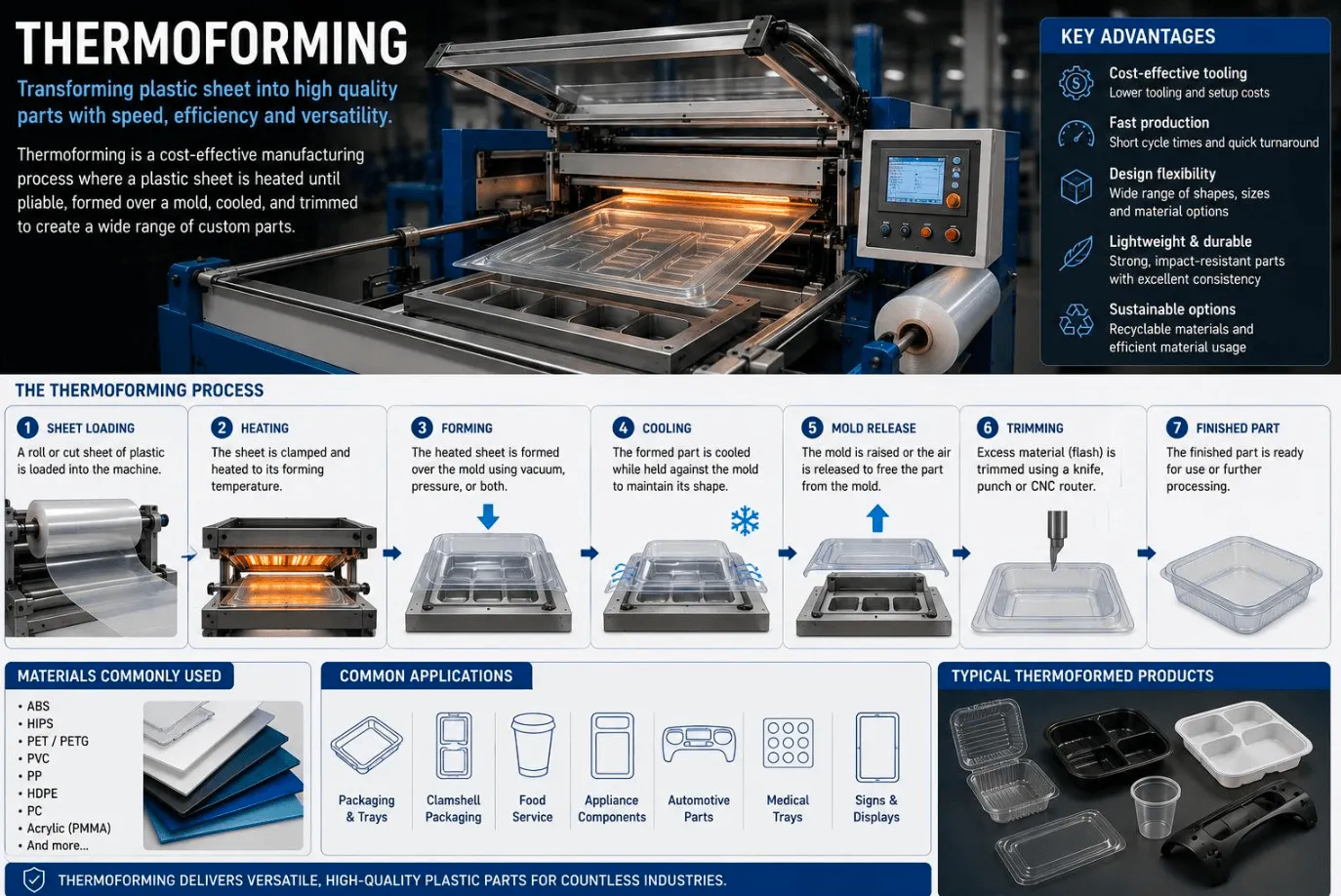
Plastic vacuum forming heats a thermoplastic sheet to its forming temperature, then uses vacuum and compressed air to pull the softened sheet tightly over a mould. It is a practical route for larger covers, trays, housings and panels where a full injection tool is not warranted, and it holds fine surface detail through high-definition forming.
We build the mould directly from your 3D CAD data, run the forming, and trim the excess material to leave a finished part rather than a rough draped shape. Drape forming and vacuum moulding of deeper profiles are handled the same way, sheet to trimmed component.
The vacuum forming service runs from first design and prototype through to pilot production, so a part can move from concept to repeatable output without changing hands. Where higher volumes or thicker walls suit a moulded route, we can move the same part across to injection moulding.
26+
Years in business
4.7★
Rated on Google
ISO 9001
Certified quality
100%
Made in the UK
Why Gemini
Form parts in LDPE, HDPE, polypropylene and polystyrene sheet, with custom colours matched to the part.
Vacuum and compressed air together, for crisp detail and a repeatable surface finish.
Tooling produced from your 3D CAD data, with excess-material trimming to a finished edge.
A complete design and prototype service that carries through to pilot production.
Thermoforming Materials & Options
Our plastic thermoforming covers a range of sheet materials and finishes, with grade selected to suit the part, the environment it works in and the finish it needs. Common materials and options include:
LDPE, HDPE, polypropylene and polystyrene sheet, in variable thickness to suit wall strength and depth of draw.
Embosses and textures formed into the surface, plus custom colours matched to the part.
UV-stable and fire-retardant grades, antibacterial additives and chemical resistance where the application calls for it.
Use Case
Blister packs are a thermoforming application, formed on the same vacuum forming machine as our other work. We develop blister packaging for the FMCG and pharmaceutical sectors, from design and CNC-cut tooling through to formed parts, with tool options that scale from 20-off mock-ups to production runs of 10,000.
Explore Blister PackagingFAQ
Vacuum forming is a process that heats a thermoplastic sheet until it softens, then uses a vacuum and compressed air to press and stretch it over a mould. Once the sheet cools and holds the shape of the mould, the part is released and the excess material is trimmed away. It's a cost-effective route for vacuum forming plastic parts, especially in low to medium quantities.
They describe the same family of process. Thermoforming is the broader term for heating a thermoplastic sheet and forming it to shape, and vacuum forming is thermoforming that uses a vacuum to pull the softened sheet onto the mould. In practice the two terms are often used interchangeably.
A mould is produced from 3D CAD data and placed inside a vacuum forming machine. A thermoplastic sheet is then clamped in and heated until it softens. Held over the mould, the sheet is pressed and stretched onto it using a vacuum and compressed air, conforms to the shape, and is held there until it cools. The part is released and the excess trimmed, ready to repeat.
Gemini forms parts in a range of thermoplastics including low density polyethylene, high density polyethylene, polypropylene and polystyrene. Grades are available with UV stability, fire retardancy, antibacterial additives and chemical resistance, in a range of colours, thicknesses, embosses and textures.
Vacuum forming suits a wide range of components across sectors such as FMCG and pharmaceutical. It's well suited to parts that need a formed sheet shape, from packaging and trays to covers, housings and panels, in simple or complex geometries.
Yes. Tooling for vacuum forming is simpler and cheaper than injection mould tooling, which makes it well suited to low and medium quantities. Gemini offers a complete design and prototype service through to pilot production, so a part can be developed and formed on the same site.
Yes. Gemini has specialised in thermoforming for many years and offers vacuum forming in the UK, with design, tooling and forming handled in-house rather than subcontracted overseas.
The mould is produced from 3D CAD data before forming begins. Because the tooling is straightforward to produce, moulds can be made quickly and cost-effectively, which keeps lead times and development costs down for prototype and low volume work.
Send us details about your part and we'll get back to you within 24 hours.